
Welcome to the 5 Questions Series. Each week, I’ll ask five questions of some of my favorite authors, editors, publishers, and other industry professionals. This week, I’m talking with Lori Green about all things horror!
Some of your horror pieces and poems that I’ve read are just stunning. What is it about writing horror that draws you in? Are there particular themes or emotions you find yourself returning to in your work?
First of all, thank you for reading and appreciating my work! Years ago, I read a quote that literally changed the way I approach writing (and reading!) in horror. “We make up horrors to help us cope with the real ones.” Coined by none other Stephen King. This gave me the freedom to explore and process past traumas. There is a certain satisfaction that comes from creating terrible things that happen to terrible people. I come from a religiously divided household, so I find that religion features prominently in a lot of my writing. Agustina Bazterrica’s new novel The Unworthy focuses on this central theme as well. I can’t wait to read it.
Horror has long been a space where marginalized voices, particularly women’s, explore fear, power, and autonomy. How do you see horror as a crucial genre for amplifying women’s voices in literature?
Well, horror has long been dominated by men, so I think it’s crucial that female authors continue publishing in, not only horror, but any genre. We must keep writing stories that give voice to the discrimination and terror that has plagued women for hundreds of years. We need these stories now more than ever. A wonderful example would be Margaret Atwood, who is not known for being a horror writer, yet wrote one of the scariest books I’ve ever read: The Handmaid’s Tale. Dystopia is its own brand of horror.
Women were the progenitors of horror. (Looking at you, Mary Shelley). Can you share some insights from your research into women’s foundational role in the genre?
Ah, yes. Mary Shelley. There’s been ongoing debate on whether she is the mother of horror or the mother of science fiction. Obviously, she masterfully blended both genres with Frankenstein and was the first to ask the question we’ve grappled with ever since. Who really is the monster? Yet, if we go back even further, Ann Radcliffe is the pioneer of Gothic fiction and her work would have influenced many writers, male or female, including Edgar Allen Poe, both focusing more on psychological terror, a subgenre of horror.

Your research has led you to a fascination with feminine rage in horror literature and film—even in stories written by men, like Stephen King’s Carrie. What do you think makes feminine rage such a powerful force in horror storytelling?
Feminine rage is such a hard thing to harness because it’s been festering for centuries. So for a man to use that in storytelling is a tricky thing because they can accused of appropriation, but male authors such as Stephen King and Stephen Graham Jones make their female protagonists undeniably human. Women who suffer abuse, but in the end take back their power either as the so-called villain, or through becoming what we call the final girl. I love character driven stories.
You’ve been researching witchcraft for another project—how do you see the figure of the witch fitting into horror literature? Do you think horror has evolved beyond the traditional “evil witch” trope, or is there still work to be done?
Different variations of the witch have always existed, even in Biblical times and I’m sure many English students were exposed to the “evil witch” stereotype if they studied Macbeth in high school. We fear what we do not understand, and women have been conveniently branded as witches when giving out herbal contraceptives and teas to terminate pregnancy. Women having control over their bodies is a battle we still fight today unfortunately. What is modern day medical science but an accepted form of witchcraft? So, I would venture to say the witch archetypes stand under their own unique umbrella as components of modern-day horror in a Gothic fashion, rather than the tired trope of blood and violence for the simple sake of it. Obviously, I’m not saying these things can’t be effective in horror, they are, but I think readers need more than that. Something that explains how certain evil is created over time, and the effects it can have on the psyche. Because in the end, I’m not afraid of vampires or werewolves, but the horrors that humans can inflict on their own species.
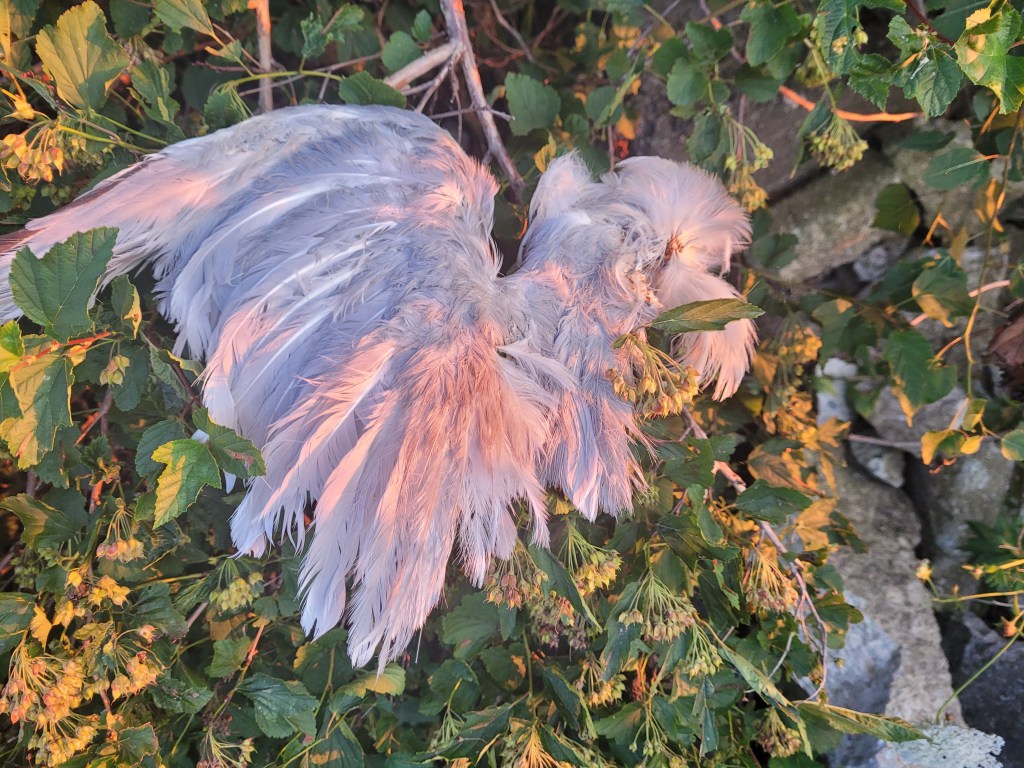
Bonus question: Have you ever taken a picture of a weird bird?
I do have a weird bird photo. This was taken along the shores of Lake Huron on a late summer evening. It’s just the outspread wing of a bird. Probably a seagull? I couldn’t find the body anywhere. Weird. It inspired me to write my poem “On The Devil’s Wings”, to be published later this month.
Lori Green writes horror, dark fiction, and poetry. Her dystopian story “In the Absence of Colour” won the bronze medal in Blank Spaces Magazine’s quarterly photo prompt contest in June 2022. Her other stories and poems have been published with Quill & Crow Publishing House, Black Hare Press, Love Letters to Poe, Off Topic Publishing, and more. She studied English Literature at the University of Western Ontario and now lives along the shores of Lake Huron. She is an active member of The Horror Writer’s Association and when not writing, she enjoys morning walks through the cemetery and researching the paranormal.
She is currently working on her first novel and other projects. You can follow her on Threads and Instagram @lorimgreen
 Finnian Burnett
Leave a comment