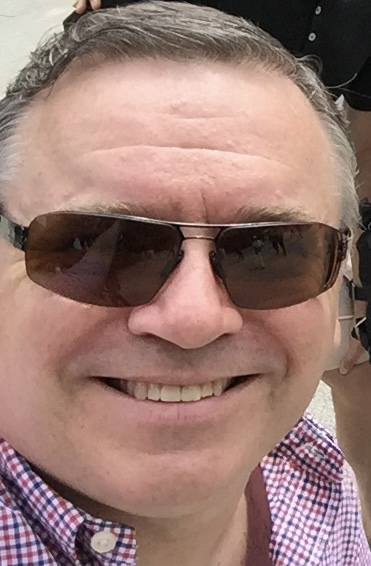
Welcome to the 5 Questions Series. Each week, I’ll ask five questions of some of my favorite authors, editors, publishers, and other industry professionals. This week, I’m talking with Andrew Shaughnessy.
You recently won first place in the Blank Spaces Magazine writing contest. What was your story about and what was the inspiration?
I am a huge supporter of Blank Spaces Magazine. We are fortunate to have a forum where writers can hone their craft through the simplicity of an image prompt all the while going head-to-head with some of the best writers in Canada. I should know—I’ve lost to them again and again. Your name, Finn, appears as a Gold Medalist three times. The ranks of Gold, Silver and Bronze prices are replete with the names of others, besides you, from my writing groups: Connie Chen, Lori Green, Lindsey Harington, N.E. Rule, Doris von Tettenborn. One of these, N.E. Rule, in a contest for Off Topic Publishing in the summer of 2023, wrote a scorcher of a story called “Ties That Bind.” The story’s final twist revealed that its main character was very much—um—not alive. I didn’t see it. It was—it is—brilliant!
I became obsessed with trying to emulate N.E.’s idea, trying to place the twist midway through my story. What started out as a rushed draft written for a NYC Midnight contest was ultimately rewritten for the Blank Spaces photo prompt contest. About halfway through the story, I let the reader know that my MC was very much not alive—the victim of a murder/arson plot. It was a bit of a dark theme for me, so the challenge was to keep it light—as light as you can make a story about a guy getting whacked in the basement of his own pharmacy. When I saw this comment from the judges—”The narrative device of a deceased protagonist observing his own murder investigation creates both irony and poignancy.”—I felt I had done it. But that comment and the win was gravy. Making the shortlist was the win for me.
What is your writing process in general?

I do a lot of prompt-based writing, where a word or an image becomes a central focus. I put that in the crucible of my mind and go for a walk and try to find a hook. In the case of my stories involving my characters Walter and Muriel, the story always starts at a kitchen table with Muriel sprawled out over the morning crossword. While my stories my begin with a hook or a start, I’m a pantster: I have no idea where they are going to end up.
I start with a germ of an idea and start writing. Shut up and write, I tell myself. It is in the editing process—when I revise and revise and revise my stories—that the story takes shape and comes to life. I do run the risk of editing the soul out of them—and that is true of my poems—but often the stories will wholly change direction and take me on an unanticipated course. When do I stop? When my beta readers’ comments have been on-boarded and my final readers—my wife and my daughter—tell me it is done.
When do I write? I don’t drink (anymore). (He doesn’t exercise either, my dog would say.) So, I have lots of time late and night and early in the morning to write before I have to take on the burden of my day job. If I am writing at night, I try to leave the piece undone so I have something to pull me in the next morning.
Do you struggle to balance your incredibly busy day job with your beloved writing time?
The poet Maggie Smith, in her famous poem “Good Bones,” has this amazing repetitive line: “though I keep this from my children.” I would write that as: “though I keep this from my partners.” The truth is I have to let some things go so I can fit it all in. I don’t watch television; I don’t go to movies; I actively find ways to make time so that I have time to write—and still have time to do my busy day job. But even when I am swamped, unless I am in the midst of the intensity of a trial, I find sneaking off to write to be deeply relaxing—my refuge in the storm.
You are an absolute genius in giving feedback. (I know this from personal experience.) What are your considerations when you’re giving feedback to other writers?
You are too kind, and it means a ton that you would say this. Feedback is hard to get. Feedback is hard to give. But we writers need it. We need the data from other readers and writers so that we can pressure test our words. Readers don’t see what we as authors see. As writers, we may have a whole symphony playing in our minds when readers are only able to hear one line—one member of the ensemble because that’s all we’ve written. A beta reader’s job is to catch that, and help the writer avoid this myopia by giving the writer points of access that they may be overlooking. The only way to do it is to do it honestly, frankly, and bravely, all with the goal of making the work better. The writer can consider, accept, implement, or reject any and (hopefully not) all comments. That is their prerogative. But they can’t do that if you don’t give them the data.
My overarching consideration is to be genuine. I can’t be who I am not. I am not smart enough to try and think what you want me to think and say of your draft. I can’t try to reimagine what you are trying to achieve. All I can do is try to leave the work better than I found it, and, in the process of communication the results, leave my writer (often a friend) in a position where they feel a little better about themselves, which leaves me feeling a little better about myself in the process. A win-win.
Last point: writers can be defensive. That’s understandable. Hard feedback can be hard to receive. But reviewers and beta readers can have thin skin too. We have to get over it. We can’t censor our comments because we are afraid of a potential negative reaction. The writers need the data. Do your job. If you do, it’s a win. Do it well and the privileged world of access to precious drafts of manuscripts will be yours. It really is a labour of love—especially yours, Finn. I feel I have gotten to know you much better as a person and as a writer.
How much of your real life makes its way into your stories?
As I tell my sister, “The stories are fictional; they are not about you.” That said, we are all derivative and there are tons of Andy’isms in my stories. Some real life too! A recent short story, “A Road Less Travelled,” an Honourable Mention in a recent Off Topic contest, featured the Burlington Skyway and a mother who stood at the side of the highway flagging down her daughter in the Hamilton Harbour. Those facts were too good not to be true. They came out of a story a client shared with me over lunch. The beautiful thing about real life is that there are moments of joy that would lose their shine if we tried to replicate them with fiction. So, why not just try to capture them crisply and precisely.
That said, I generally steer away from CNF, even though I have won in the genre. I will say this: that those stories get written faster, and with fewer revisions, than when I am making it up. While I like the freedom that comes from imagination, I guess I like the guardrails that real life gives me.
(As in my day job, I’m totally making this up.)
Bonus question: Have you ever taken a picture of a weird bird?
Here is a picture of a Northern Barred Owl, staring and scaring the poop out of us during a Thanksgiving walk a few years ago. I wasted too many hours trying to research the meaning of seeing an owl in the woods only to have my daughter remind me that the bird bore, on its chest, the shape of a heart. (I may use that in a story, he might have said before you asked him that question, my dog would say.)


 Finnian Burnett
Leave a comment