
Welcome to the 5 Questions Series. Each week, I’ll ask five questions of some of my favorite authors, editors, publishers, and other industry professionals. This week, I’m talking with Premee Mohamed.
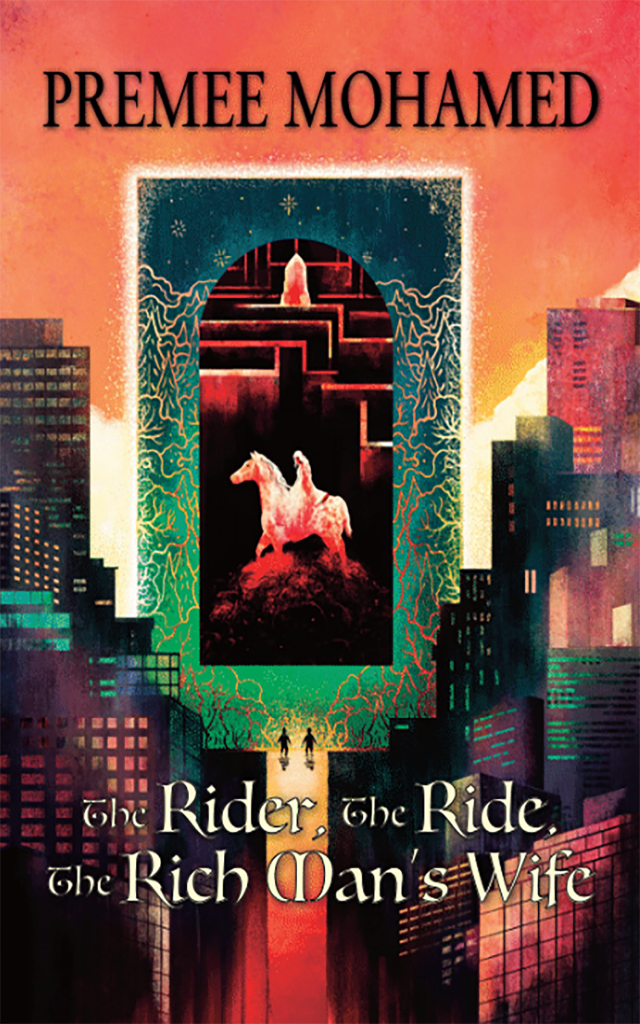
I have to start by acknowledging you have four books out this year! (THE BUTCHER OF THE FOREST is one of my favourite books of the year!) How do you manage to find time to write, edit, promote, and you know, just generally be a human being?
Something something glass balls rubber balls… basically, the short answer this year is that I’m begging for a lot of extensions, skipping sleep, and skimping out on being a human being. Probably later on I’ll look back at 2024 and think, “Wow, I was NOT at my best that year,” but that’ll have to be far in the future. Right now the entire year and most of 2023 is a blur of stress and deadlines. (And frequently cursing Past Me for being a dick to Future Me.)
I apologize to readers of this blog who were expecting some sage discourse about time management and prioritization but the truth is, I’m bad at both. I have severe ADHD, I’m disorganized, and my only saving grace as a writer is that I live alone and can therefore allow the house to slowly deteriorate while I pour all my resources into other things.

You are a scientist (GO SCIENCE) and a writer. How does one inform the other?
GO SCIENCE! It’s funny, this is a question I get a lot. I’m still never sure how to answer it, because both are so inherent to who I am that I can never pick apart which way the influence or inspiration goes. I’ve wanted to be a scientist since I was very young, and while I’ve been writing fiction for about the same amount of time, I didn’t start seeking publication until a few years ago. So I’ve spent nearly a quarter of a century doing science or working in science-adjacent fields (industry, policy, consulting) and being very much immersed in that world—it’s still writing that gives me impostor syndrome, not science.
I will say that I’m positive that learning how to research (not just how to find information but how to evaluate the source, who’s doing it, what their agenda is, how it relates to other research, what’s novel about it, why it was worth doing, what will happen to it next, whether it’s sketchy or reputable, etc) does make it easier to write fiction, because it’s very much the same process. In both cases we’re looking for ideas that connect in interesting ways, facts that may not seem related but work together to create something new, questions that can maybe be answered in ways to generate more questions—basically, both good science and good fiction are looking to generate emergent properties from a whole lot of meaningless data, to pull meaning out of chaos and give it a recognizable pattern that the engaged reader can understand and even act on. That’s what we’re attempting in both cases: a shape, boundaries. Abstract, methods, results, discussion, conclusion is not terribly different from a dramatic five-act structure.

You have two books coming out in 2025. Can you tell me about them?
The first, ONE MESSAGE REMAINS, is coming out in February from Psychopomp! I am super excited about this one—it’s a weird format and I like weird. So basically it’s a mini-collection: one new novella, two new novelettes written to go with it, and one reprint novelette (THE GENERAL’S TURN, published in The Deadlands in 2021). They’re in a shared world, or I think they are anyway. All of the stories got away from me to some extent, and with great dexterity considering their lack of limbs.
THE GENERAL’S TURN is one of my favourite things I’ve ever written, and I love that my editor (E. Catherine Tobler) kept a very light touch on it. It’s a story about war, about tradition, about theatricality—about how some people do just want to watch the world burn, and some can’t do it unless they have an audience to validate them. I think the other stories explore the same themes; what do we owe to governments, systems, institutions? (Is family one of those things, or something else? Is it at the same level, or somewhere else?) What do we owe to justice? Who gets to say what justice is? If your enemy isn’t fighting ‘fair,’ do you pick a different enemy or do you redefine what you consider fairness? I guess I enjoyed asking a lot of questions in these stories that don’t have nice clean answers.
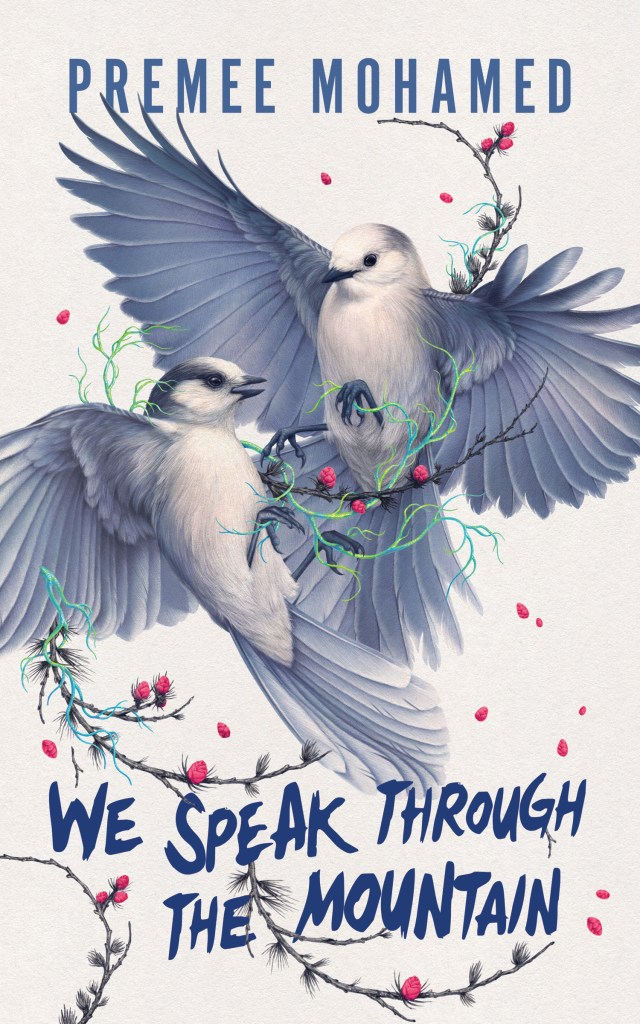
The second book, THE FIRST THOUSAND TREES, is the final book in the trilogy that began with 2021’s THE ANNUAL MIGRATION OF CLOUDS, from ECW Press. I’m excited for this one too—the first two books (CLOUDS and then WE SPEAK THROUGH THE MOUNTAIN, which came out June 2024) are from Reid’s perspective. She’s got a particular world-view, one shaped by having a chronic illness, having a mother with the same disease, the opportunities and limitations of her life, the anger she carries about the climate disasters that predated her birth by decades. But the third book is narrated by her best friend, Henryk—the one she leaves behind when she chooses to explore the world outside their little community. And he, as you might expect, has a very, very different experience from her as he travels up north to see if his remaining family will take him in. And it’s funny, it’s not that (as far as I can tell) any readers were clamouring for a Henryk book. But it’s what I wanted to write to wrap up the trilogy, and I’m so pleased that my editor (Jen Albert at ECW Press) was like, “Go for it! Follow your instincts!”
I will also have several short stories out, including one in the Stephen King THE END OF THE WORLD AS WE KNOW IT anthology! I’m stoked for people to pick that one up. I haven’t gotten my copy yet but I imagine it’s going to be one of those really nice fat volumes (34 stories!). And they’re all based in the world of his novel THE STAND, though we were allowed to pick whether we wanted to write our stories set during or after the book. Mine, entitled HUNTED TO EXTINCTION, is set quite a bit after, when people are starting to get… how shall we say it… a little too comfortable in non-supernatural explanations for things.

You write across genres and forms. Short stories, novellas, books… what appeals to you the most and why?
Honestly, I’m a novel guy—not just because it’s easier to tell people “Yes, I’m a novelist” rather than “Technically, if you go by numbers, I’m a novella-ist.” And short fiction constantly horrifies me. It is the hardest thing in the world to write a good short story, and I can say that very confidently despite having won awards for my short fiction. It’s so hard! How do people do it on a regular basis?! How do you just like, craft a perfect little gem in 2800 words, when I desperately want to explain every single thing in it at the novel length?
I also confess to liking the novella length (as you can probably tell from my publication history). It isn’t just that it’s quicker to write a novella because it’s shorter (although, let’s be real). It’s also that there’s a kind of purity to a novella that makes it both not merely a shrunken-down novel (with all its themes, subplots, and characters given short shrift after cruel miniaturization) or a fluffed-out short story (with tangents, irrelevant scenes, and extra characters for unneeded padding). A novella tells a single story, keeps its focus on forward movement, its shape is one smooth arc, and the only purpose of the length is to explore the premise of the story in enough depth to show the shape of the arc. It’s also a great length to experiment, in my opinion. Too short and the reader can’t perceive patterns that take some time to build; too long and any literary gimmick wears thin. I mean, I don’t mind annoying readers, but there’s a difference between annoying a reader and insulting their intelligence.
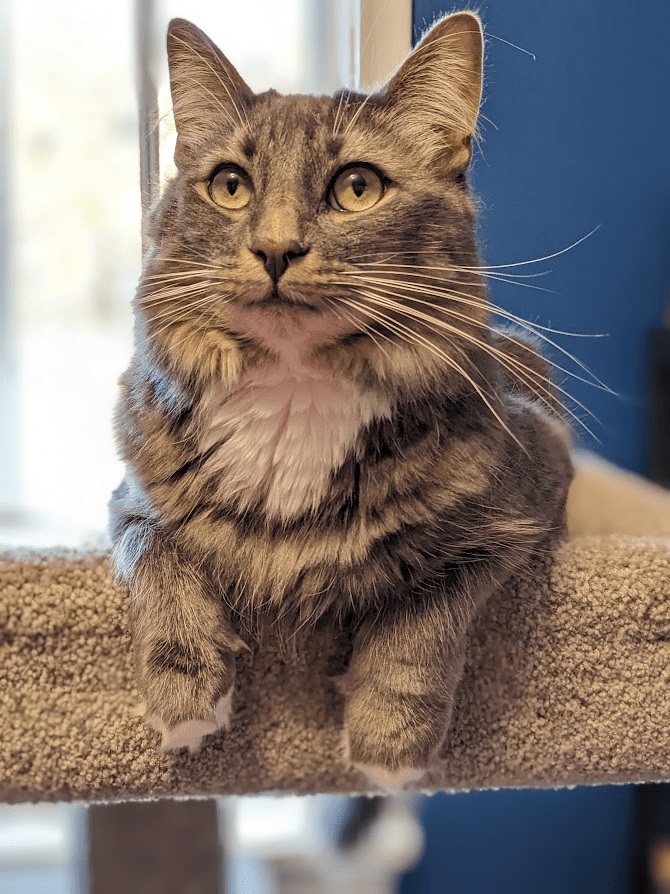
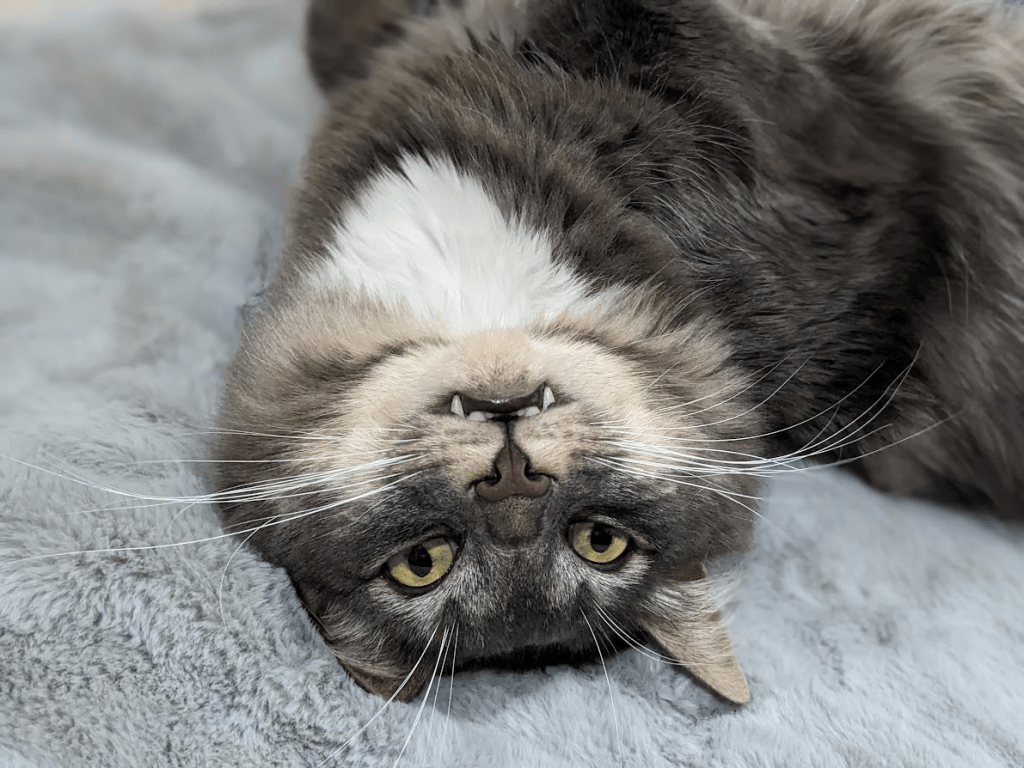
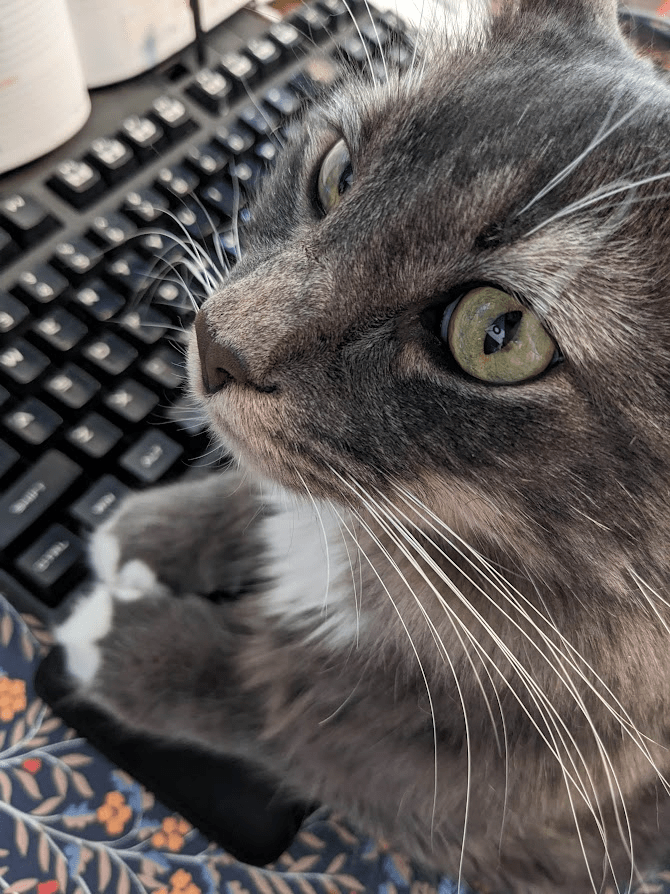
You have a fuzzy writing assistant? You know I want to see a picture! Does he show up in any of your fiction?
Writing OBSTACLE! Useless, useless man. Attacks my mouse, kneads my wrist rest, blocks my keyboard, sits directly on top of my notebooks, steals the lids off my pens, says “YO DE LAY HEE-HOOOOOOOOOO” at top volume when I’m on calls with editors. He does NOT show up in any of my fiction because he is a LITERARY NEMESIS.(Ed. Note. The Writing Assistant™ is dreamy, adorable, and absolutely above reproach. See photographic evidence below.)
Bonus question: Have you ever taken a picture of a weird bird?
All birds are weird. It’s like they’re trying to remind us that they’re dinosaurs. Anyway I feel like these little urban parrots in Barcelona should count! I was just sitting there trying to eat my bread and olives and then was like, “What’s all that noise? Wait, are those PARROTS?!!?” Please note the non-weird bird in the distance (a pigeon).

Links to books and more information about this incredible author can be found on the web here.
 Finnian Burnett
Leave a comment