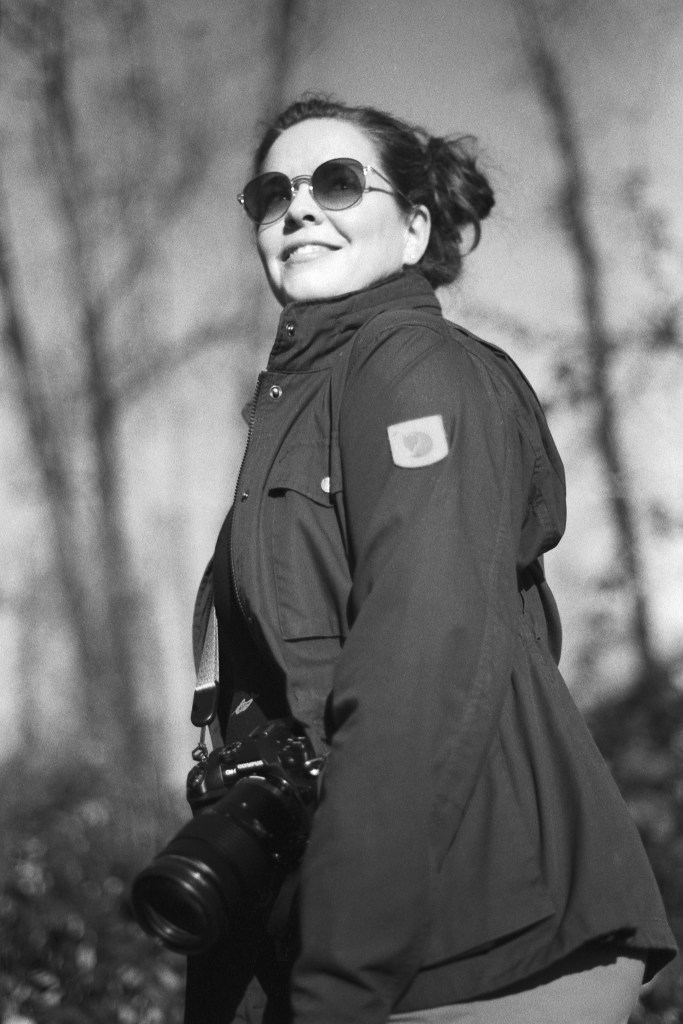
Welcome to the 5 Questions Series. Each week, I’ll ask five questions of some of my favorite authors, editors, publishers, and other industry professionals. This week, I’m talking with Tara Avery.
I’m not surprised to know you have an acting background. (You brought ALL THE DRAMA with your goth and glam outfit at the Surrey International Writers’ Conference). But I am curious about that journey and how it led to writing.
I’ve always been a storyteller. For the most part, I share stories by writing them down. But from childhood, I’ve also gotten a kick out of performing stories. As a child, this meant I often corralled my siblings and the neighborhood kids into participating in whatever story I came up with. Sometimes, they were the co-performers (in the most depressing plays I could think up and/or in melodramatic enactments of Chris de Burgh songs); other times, they were the audience (usually while I convinced them that ghosts 100% lived in our house or on our street). Fortunately, I had some teachers early on who supported (enabled?) this, so I acted in as many stories as I created myself.
My junior high and high school had an oddly robust writing program, including an annual young author’s conference that attracted some pretty well-known authors. I also took as many theatre classes as the school offered.
Although I’d written novels all through my school years, at the end of high school I experienced what I now consider my first real bout of writer’s block. I started the Honours English program at UBC and stuffed my extra credits full of theatre classes. At the end of my second year, I decided I would audition for the theatre program. Looking back, I think I desperately wanted to find a way to remain a storyteller, even if my own words weren’t working. (If you can’t make your own stories, store-bought is fine?) And talking about stories wasn’t quite cutting it. (I’m still proud of the way I managed to mention Pride and Prejudice in almost every paper I wrote, though.)
I loved acting; I loved performing. But (in what will likely emerge as a theme throughout these answers) I didn’t love abdicating so much control over the entirety of the story. As a novelist, after all, you get to design all the sets, play all the characters, and control all the action. As an actor, your slice of the creative pie is much smaller, even when you’re absolutely enjoying the collaboration integral to theatre.
That said, everything I learned as an actor enriched the way I approach storytelling as both an author and an editor.
And I will still drop everything if given the opportunity to put on a costume (and a character).
You’re part of the Federation of BC Writers. What brought you to the board?
To answer this, I have to first explain that I’m an editor as well as a writer, and that I’ve been a member of the National Executive Council of Editors Canada for about two and a half years; I’m the treasurer. I’ve also held several positions in my local Editors Canada branch, Editors BC (formerly: co-chair of communications and social media and treasurer; currently: chair). Last year, I co-chaired the national Editors Canada conference in Vancouver with one of my Editors BC partners in crime, Kyle Hawke.
Through these positions, I’ve ended up working with the FBCW (and with Bryan Mortenson, their executive director) frequently. A few months ago, their board had shifted a bit—a board member took on a staff role, etc.—so they needed some fresh meat blood faces. I was absolutely not supposed to take on any more volunteering (insert side-eye emoji), but … well. Here we are. And I will say this: the stuff I do with the FBCW feels a whole lot more like having fun with my pals than work, so I don’t regret the decision.
I still, um, haven’t told my husband (the person to whom I made the promise that I’d cut back my volunteer hours insert side-eye emoji again) that I’m not just on the board, I’m vice-chair of the board, though. Oops. I slipped.(Ed. Note. Your secret is safe with me.)
Whenever I urge people to join the organization, I always feel like I have to say, “I’m not encouraging you to join the org because I’m on the board! I’m on the board because I love the org.”
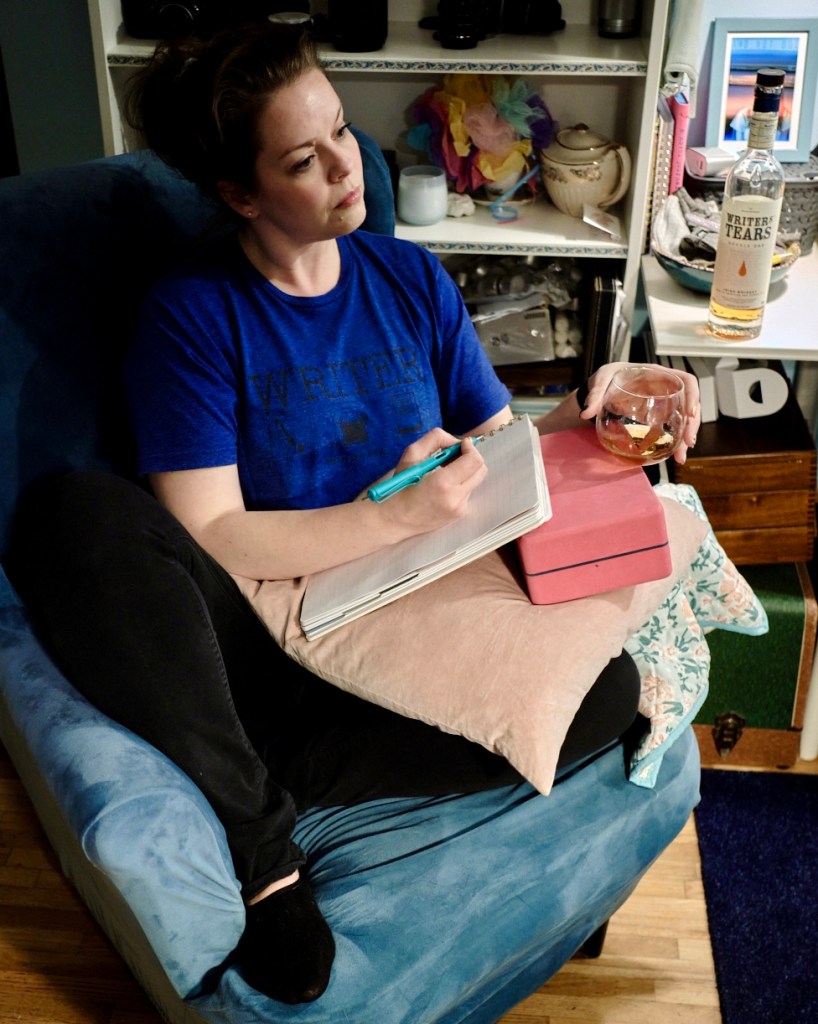
Why would you tell people to join FBCW?
Because in the next question, you’re going to ask me about the importance of writing community, and the FBCW has community in abundance.
The FBCW’s membership has grown enormously in the past four years, and the programming reflects that. Even if one thing doesn’t resonate for you, chances are the next event will! The organization is also incredibly open to suggestions, so if there’s something the members want to see? They really just have to propose it.
The Fed is genuinely welcoming. It is genuinely warm. And it is genuinely enthusiastic about supporting its members. I’m one of those way-too-intuitive, way-too-sensitive types who can spot disingenuousness a mile off, and no one I’ve met or worked with at the FBCW has ever sent that red flag up the pole. I’m not sure if I can put into words how rare that is.
Real talk: my drug of choice is enthusiasm. I am addicted to enthusiasm. And I’m not sure if I can put into words just how vibrantly enthusiastic the organization and its members are. Finding peers who match and feed your energy is just such a gift. I hope—and believe—that the FBCW is that for many writers, not just myself.
How important is writing community to you and where do you find it?
Writing community isn’t just important, it’s necessary. Vital, even. When I look back at my life, I see that nine times out of ten when I didn’t have a community? I made one. Or I was absolutely miserable without one. Not to be melodramatic, but my writing community(ies) have saved my life.
In grade five, I founded The Children’s Monthly News (titles are the WORST; that never changes) at my school; we wrote about thrilling topics like the first iteration of The Teenage Mutant Ninja Turtles (Leonardo5eva) and Sweet Valley High and Babysitter’s Club books, because that’s how old I am.
When I was eleven, I tried to get my best friend/next door neighbor to write a dual-POV novel with me. She wrote a chapter and gave up. I wrote a trilogy.
In junior high, I started a Dragonlance club; several “members” were also writers. One of my best friends actually recorded baby’s first audiobook (i.e., read my whole book out loud onto cassette tapes). I moved to the other side of the country and although it took a year, I also ended up with a group of writer friends there, too. We made up a world, populated it with our characters, and then wrote stories set in it. I was the High Queen. Because I’m humble like that. That group carried on through high school. Most people wrote a story or two. I wrote a trilogy. And then some.
Toward the end of high school, the internet became a Thing, and I discovered fandom before I had any idea what fandom really was. Since then, I’ve more or less always been actively involved with one online fandom space or another—as a writer, yes, but also as an organizer of kindred spirits and the friendly neighborhood writer/editor/coach folks can come to with their questions. Fandom is where I met my current best friend and co-writer. We wrote an embarrassingly long fanfic and then I said, “Hey, want to try something that might one day get us paid?” (She said yes.)
This past SiWC was my fifth in a row, and I don’t see myself skipping it unless it’s for reasons absolutely out of my control. As conferences go, it’s stellar, and I also find it tends to attract a disproportionate number of kindred spirits, as it were. Its vibe probably isn’t for everyone, but damn, it’s definitely one that resonates with me.
And then there’s the FBCW, which is becoming nearer and dearer to me every passing day. (They’ll need a High Queen eventually, right?) (Ed. Note. I support this ambition.)
What are you working on now?
I spent most of my writing time in the last couple of years ghostwriting/heavily rewriting three and a half books of a series. Ghostwriting is a weird gig because even though you’re working with someone else’s idea and mimicking someone else’s style, you still put a ton of yourself into the work. The plus side, of course, is that you get a guaranteed paycheck. The minus is that while you know how much writing you’ve done, no one else does. And it doesn’t get your name on it. When the first book in the series went live, I imagined it felt a little like giving up a kid for adoption. I can look in to see how it’s doing, but I no longer have any relationship with it.
Between freelance editing and freelance (ghost)writing, I’ve been devoting a disproportionate amount of time to the words of others. So, my goal for the next little bit is to return to my own. It’s … really hard, actually.
As for the work itself, I’ve got a list. I’m starting a new sci-fi novel that’s, um, becoming more relevant by the day. My best friend and I are working on a series of books (we wrote a book! Yay! And then we realized we’d written the second book. All that stuff we kept handwaving came back to bite us. So, we’re working on the first one now). I’ve been writing a little poetry; I’m nursing the idea for a play; I have about four or five novels—or beginnings of novels—with good bones that need reworking.
The aforementioned best friend and I are also trying to start some kind of online community for writers. Oh, and I’m working on an in-person “Acting for Writers” series of workshops. Not because I want to terrify the introverts into performing—I am an introvert!—but because writers can learn so, so much from approaching characters and storytelling the way actors do. And there’s always fanfiction.
(Why yes, I do have ADHD and constantly feel like I’m doing nothing… until I actually stop and write down what I’m doing. And then I just feel TIRED.)
Bonus question: Have you ever taken a picture of a weird bird?
I took a pretty horrifying picture of an eagle, um, eating a duck. While the duck was still alive. It was a real circle of life moment, but without the cute talking lions. Unfortunately (fortunately?), I can’t find it. Instead, here’s one of me getting to hold a raven on my arm in Edinburgh. One step closer to my witchy dream of having a raven familiar. (I would also like a fox.)

Tara can be found on the web here.

 Finnian Burnett
Leave a comment