
Welcome to the 5 Questions Series. Each week, I’ll ask five questions of some of my favorite authors, editors, publishers, and other industry professionals. This week, I’m talking with Christina Myers.
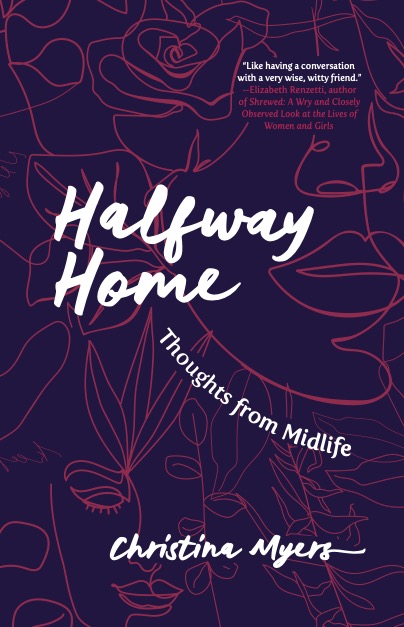
Thank you for agreeing to meet with me. First, I’ve been hearing so much about Halfway Home! Congratulations on your launch. Would you be willing to talk about that collection? What inspired it?
Thank you! The last few months have certainly been a whirlwind and I think (knock on wood) it’s been well received so far, but time will tell. So, the book is called Halfway Home: Thoughts from Midlife and it was published in May by House of Anansi. It’s a collection of essays that rove over a huge amount of territory – we summed it up at one point by describing it as “from first bras to first signs of menopause.” So it’s all of that and more – about puberty and gender expectations and bodies and diet culture and growing up as a child born in the 70s, through to witchcraft and the climate crisis, and conversations around identity and menopause and aging. Did I mention it covers a lot of territory? It’s really about being this age (almost 50) at this time in the world (housing crisis, climate change, cultural shifts) and looking back over what we’ve been taught to believe, and looking ahead to what may be coming, with a lot of uncertainty in there.
And that’s really what inspired it – literally just me being like “holy potatoes, where am I now? How did I get here? What’s around the corner” and realizing that I was having all of those conversations internally but so were most of my peers. And we all felt kind of weird and a bit isolated in that. Like everyone thinks you’re supposed to have things figured out by now and in some ways you do – you start to shift off other people’s expectations of you and your own becomes so much more primary – but in a lot of ways you’re always still learning how to be you, right now, in this time. Like I’m a parent of teens now and I’ve NEVER been a parent to teens before – I don’t know what I’m doing! Whatever stage you’re in, it’s always new to you and you’re always still figuring things out. And I write, to figure things out.
You edited a collection of non-fiction essays about life in plus-size bodies, Big. That collection resonated with me, and apparently, a lot of other people. Why do you think people were ready to read the truth about fat bodies and what would you do differently if you were putting that out today?
There was a lot of great work out there already that was speaking to this topic – certainly a ton of great individual memoirs from various writers, mostly in the US, and a lot of great academic work coming out of gender studies and women’s studies and related fields. A lot of it, particularly the academic work, was and is really revolutionary stuff, really picking apart roots of fat stigma and fat phobia and all the associated junk there (surprise surprise, lots of it is rooted in racism and homophobia and patriarchy.) So, for me the anthology was really just adding to a conversation that was already going on for a long time, but I think – I hope – it pulled in some readers who might not have been engaging with those conversations yet. When you’re inside a conversation already it’s hard to remember there are people who aren’t even aware the conversation is happening. So I wanted a book that included a lot of powerful voices, people who knew where they stood, people who were individuallly engaging with fat activism … but I also wanted people who were just like “I’m not sure, I feel really messy about my body and about the world it lives in sometimes, but I’m trying.”
I always say that we can know intellectually that beauty culture is garbage and designed to make us feel like crap and to buy more stuff and to just keep hating ourselves – we can KNOW that … but then every day we have to go back out into the stew and swim in it all day. It’s not simple and straightforward. It certainly isn’t for me. I have days where I’m terrible to myself, inside my own head, things I wouldn’t say to my worst enemy and then I think jeez what a fake you are, you put out this book and you still have weird self-image garbage going on inside? I don’t know that these things will ever be resolved for me entirely – I was born in the mid-70s, grew up in peak diet culture, my weight was a huge aspect of my childhood/teen years, and shedding all of that entirely is tough work. I think it’s important to acknowledge that none of this work is linear or perfect; we do what we can, we fall back and keep going.
What would I do differently? I think that book needed more queer voices, more people of colour; there was some but it needed more. That’s on me, I didn’t do a good enough job spreading the word and making sure as many people as possible heard about the call. And I would do it with a co-editor, someone to bounce ideas off, someone with a very different background than my own with their own perspective.
People have asked me if I’d change the title if I did it again, because the title got some heat which I heard about indirectly through the old grapevine (nothing is secret for long in this world lol). I know there were people who thought it was copping out to have a book about being fat that didn’t include the word in the title. I don’t know that I’d change it. It was a decision I thought about for a long time and was intentional – we had more than one conversation about it with the whole team at the publisher’s. I’m good with the word “fat” myself, I have wrestled with what that word used to mean, how it was intended to shame and I’ve shifted away from that. But it’s still a really loaded word for most people. I didn’t want the title to dissuade a reader. Like I said in an interview on this once, I don’t need to convince the choir that’s already singing inside the church to come listen to the sermon … I need the person walking by, who hasn’t learned anything at all about the sermon, to smell the coffee and hear the laughter and decide it’s worth coming in the door. I thought a lot about the reader – people like my mom and my aunts, who grew up in a time when to be fat was about the worst sin a woman could commit, and friends and peers who aren’t even aware there are conversations and activism going on in this realm – and I knew that a brightly coloured, cheerful cover (also very intentional) and the word “big” would invite in more of the people on that sidewalk. Like, really – fat stigma runs so deep that there are lots of people who would be embarrassed to bring the book to the cashier, because of the word on the front cover. Is that copping out for me to not use it then? To bow to that? To know it might freak people out? Maybe. But I hated the possibility of missing the reader who needed this book, so I didn’t use it that way. I know people disagreed with that, and as a people pleaser that is tough for me. But it was intentional and considered, and I heard from so many readers who basically said that approach worked: they’d say “gosh, the cover pulled me in and I’m so glad it did.” And many of them were encountering brand new ideas there. Maybe the sequel could be called Big 2: The F Word and the essays could include ruminations on the word itself? But someone else can do that book – I need a few more years to recover, it was a lot of emotions, to work on that book!
You have another collected work coming out this year? Can you talk about that?
Yes! My friend, Oga Nwobosi and myself are working on an anthology right now on the topic of post-partum depression as co-editors. Oga and I met in a PPD support group after the births of our first children. She and I both come from journalism backgrounds. Over the years I had thought about this project many times and finally one day I just sent her a note and said “hey, I have this idea and every time I think about the idea, the universe shouts at me to talk to you, are you interested” and the response was immediate. She’d been thinking about the same thing for years, wanting to create some kind of book around this topic and not really being sure where to start. So we sat down and brainstormed and wrote a proposal, and then reached out to the publisher that did Big with me and they were on board. We just closed the submission call and we’re going through the submissions now. We’re hoping to be out in 2025 but no set date yet. The working title is Beyond Blue but we’re not sure if that will be the final, in the end.
What advice would you give emerging authors on finding an agent or publisher in today’s literary market?
Just keep doing good work. Your work will speak for itself. And be brave. Be willing to get the “no.” Be comfortable with risking your pride and sounding silly and getting the rejection. Almost every single good thing that has happened for me in my writing career came after I wrote an email and closed my eyes and hit “send” … or I dialed a phone number and started talking before I could convince myself to hang up … or I held my breath and clicked “submit” on some contest or another. I know that’s not practical advice but I think it’s real: don’t be worried about being told no, be worried about getting to the end of things and you were so scared of the no that you didn’t try.
And be polite, for heaven’s sake. The publishing world is small. If you’re a jerk or hard to work with, it will get around fast.
What are you working on next?
I’m almost done (like, the finish line is in sight) the draft of my next novel, tentatively titled Borderlands, which is about a massive natural disaster and three characters here in BC who find each other in the fallout of that event. It’s been supported by grants from both the Canada Arts Council and the BC Arts Council, so I feel really, really grateful about that. It’s very different than my first novel and, of course, very different than my essays. I’m also working on a proposal for another non-fiction book about community and food and eating together. I have a hard time staying in my genre lane, and many of my ideas jump from genre to genre and from one area to another within a genre (I have some romance ideas outlined for down the road, too and I’m hoping to work on a co-written novel with my sister that has a sci-fi bent to it.) A writer friend once described me as having genre commitment issues, and it’s true. I just get excited about different things!
Bonus question: Have you ever taken a picture of a weird bird?
As luck would have it, I took this picture today – not weird, but beautiful (though you don’t want to get close in nesting season, then they’re not beautiful but terrifying dinosaur-like monsters!)

For upcoming events, book news, social media or to subscribe to Christina’s newsletter:
https://linktr.ee/christinamyers
 Finnian Burnett
Leave a comment