
Welcome to the 5 Questions Series. Each week, I’ll ask five questions of some of my favorite authors, editors, publishers, and other industry professionals. This week, I’m talking with Maria McLeod
First, your work recently appeared in volume 2 of Anodyne Magazine and they named you their featured writer for the issue. Can you tell me a little bit about those pieces and the inspiration for them?
Between 2018 and 2024, I had three surgeries. They included two surgeries six years apart for breast cancer, diagnosed in one breast and then in the other, and a third surgery for suspected ovarian cancer and severe endometriosis, which resulted in a complete hysterectomy. I did not have ovarian cancer, but the endometriosis — which had been undiagnosed for many years despite obvious symptoms — had created a pre-cancerous state that very well may have turned into cancer down the road. So, those were the topics that were occupying my mind, which is how they ended up subjects for my poetry.
I wrote “Pink Roses” first, which is related to my first biopsy for breast cancer in 2018. I often find the cliché feminine artwork featured in medical settings focused on women’s health (i.e. mammography and gynecology) absurdly consolatory. So, I think the poem started there, the image of pink roses as wall art. Of course, the poem is less a critique of the art choices and more about a moment, the hinge between the pre-diagnosis and post-diagnosis, between benign and malignant. It’s a feeling of dividing in half, oneself with plans for a happy and healthy future, and the other self suddenly redefined as ill, facing one’s mortality — a reckoning scene.
“Grateful,” is more of a rant poem that felt cathartic to write because, of course, I’m angry that so many of us go through these forms of cancer. So often the characterization of the cancer patient, the media framing, is of a person who is grateful, but that ignores the reality of becoming a medical subject. You enter a medical machine that has its own norms and protocols to which the subject, the patient, is expected to adhere. Because most of the experience is physically and emotionally difficult, “grateful” becomes a reductive characterization and misnomer as a summary of subject’s overall experience. The third poem, “For the Taking,” falls under the category of rant poem as well, but that poem moves away from the personal and addresses the universality, “the us,” of the breast cancer patient experience, especially aspects which feel dehumanizing and/or demoralizing.
I read a flash fiction piece of yours, Poly Di, in Cease Cows Magazine and I can’t stop thinking about it. Can you tell me about the writing and publishing process for that story?
Firstly, thank you for looking up that weird little prose poem, which I’m so happy Cease Cows published. That piece resulted from my work on contract to produce a book detailing the history of the Washington State Department of Ecology. It was a year-long project, during which time I conducted several interviews with environmental experts, creating an oral history of the agency’s first 35 years. Not being a scientist, I was overwhelmed, frankly, by what I was learning, especially about everyday chemicals — EPA-permitted chemicals — that were wreaking havoc with the environment and our health. The chapter I produced that most concerned me was on persistent bioaccumulative toxins, such as flame retardants that were used in all sorts of domestic products (till 2013), but which humans absorbed through breathing household dust, or consumed as residue in foods, or encountered through another household product. Most disturbing was the fact that flame retardants were present in human breast milk, which infants then consumed. So, “Poly Di,” short for Polybrominated Diphenyl Ethers, was the name I chose for the baby that is the subject of the poem. In a weirdly fantastical way, she personifies the toxic flame retardant and references or enacts the potential biological ill effects of PBDEs upon the body.
So, that poem, “Poly Di,” although somewhat tongue-in-cheek, was a way of voicing concern, my alarm bell. It wasn’t until later when I was diagnosed with cancer and endometriosis that I, too, began to understand my illnesses were likely caused by endocrine disruption I’d experienced during puberty from exposure to toxic chemicals.
I’m fascinated with your work, particularly as it pertains to health and the female body. Can you tell me about the one-woman show you wrote in grad school and what that has led to in your current work in progress?
Great question! I grew up as the eldest of four with three younger brothers. No sisters. This was long before there was much, if any, awareness that gender was a construct and that the polarized characterization of man/woman didn’t reflect the reality of the gender spectrum. Something I clearly remember happening during my adolescence was that suddenly it wasn’t acceptable for me to engage in activities more traditionally assigned to boys. This was made obvious because of the difference between behavioral expectations for me versus my three brothers, to which I objected.
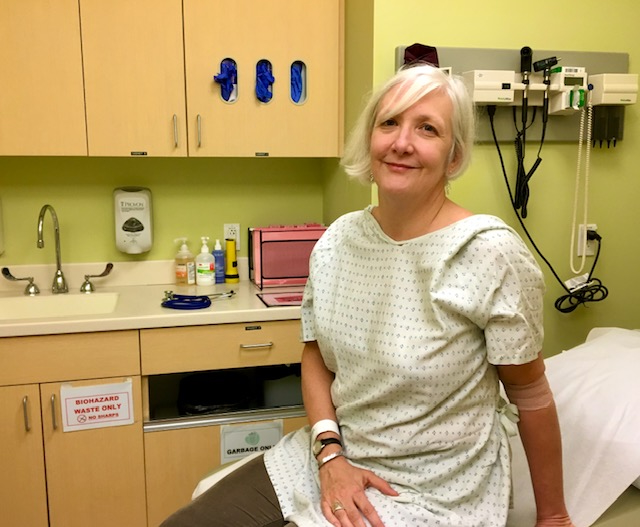
This gender division was further emphasized when I began seeing gynecologists for routine exams. I encountered a series of questions typically asked of me (and other women): date of first menstruation, number of sexual partners, number of live births, number of abortions and/or miscarriages, diagnosed sexually transmitted diseases, type of birth control, etc. Socially, this suggests that the onus of having a sexual body, which can result in sexual diseases, pregnancies, etc., is unfairly placed upon women as they must confront these issues when they interact with medical professionals. Boys and men were not questioned in this fashion. I knew this because I questioned my brothers. They had never been asked what form of birth control they were using, or questions related to their sexual behavior, or questions that suggested they had any responsibility related to reproduction, which I experienced as entirely sexist. Also, I found the questionnaires were biased, favoring heterosexual women. Furthermore, many of those questions were more complicated to answer than the space provided. So, I would say that my one-woman show, titled “Sexual History Questionnaire,” addressed that. Also, I should add that I filled the theatre with sexual history questionnaires — one on every seat — and I peeked from backstage to see people baffled and offended to be asked those questions, which was exactly my goal, to create the context for my performance where they felt the intrusiveness of having to account for their sexual behavior and experiences. All these years, post MFA, I’m still interested in and writing about topics related to sexuality and equity.
Why do you think it’s important for you to write about bodies and health?
See responses to questions one, two, and three. (Ha!) I’m only half kidding. Here’s where I must express how thankful I am to Anodyne Magazine for creating a space for these narratives. I feel as though I’ve waited my entire life for a publication like this to arrive. In general, here are my top three reasons for writing about health and the body (as a feminist):
One: Because the male, cisgender body is still considered normative in the medical realm, especially in terms of research.
Two: Because health issues — the protocols and norms of health care and access to medical treatment — is indicative of the social biases, inequities experienced by marginalized populations, and the disparities between rich and the poor.
Three: Because counter narratives from the *FLINTA community — whether it be visual art, prose, poetry, scholarly research or hybrid works — are necessary for a more inclusive understanding of critical health issues. [*Female, Lesbian, Intersex, Trans, and Agender]
Is it challenging to switch between academic writing and creative writing?
Yes, I would describe the switching as a slow process rather than an off/on. Also, I literally cannot do both at the same time, at least not the generative aspects. I can edit creative work when engaged in academic or scholarly work, but I need to be in a different headspace and immerse myself in creative writing of others, swim in their work and words, before I can generate my own. The one through line is that my academic work of late is related to the use of personal narratives/testimonials to promote cancer care centers. I’m interested in the media framing, and the editorial choices made, in the representation of the cancer experience. The process of production, however, feels very different and distinct from the creative process. In general, I write creatively in the summer and work on academic or scholarly writing during the school year.
Bonus question: Have you ever taken a picture of a weird bird?
Yes. I’m somewhat obsessed with the Evening Grosbeak, which is a bird that is native to the Pacific Northwestern United States. They’re beautiful, chirpy birds with parrot-like beaks. They appear to be highly sociable and arrive late spring, en masse. This one held very still for the photo as he was a little stunned from smacking into my window. Eventually, he flew off to meet up with his friends.

 Finnian Burnett
Leave a comment