
Welcome to the 5 Questions Series. Each week, I’ll ask five questions of some of my favorite authors, editors, publishers, and other industry professionals. This week, I’m so happy to speak with my dear friend, poet and academic Emily August.

Thank you for agreeing to talk to me. I’m so excited you have a poetry book out. Can you tell me a little about this book and the process of getting it published?
It’s my pleasure, and thank you for these rich and wonderful questions!
My debut poetry collection, The Punishments Must Be a School, explores intertwined legacies of personal, familial, and cultural violence. Populated by brutal healers who inhabit gothic landscapes, the book considers how violence is passed down through generations, altering the individual bodies it touches.
Back in 2005, I wrote the very first poems that would eventually become this book. I was attempting to understand and process my own experience with intimate partner violence, which had occurred when I was an undergraduate teenager. Perhaps one or two of those earliest poems survived into the final manuscript. In the intervening years, my perspective widened and deepened as I reckoned with my own haunting family history, as well as my experience of schooling and the toxic effects of education on my mind, body, and spirit. I also started very gingerly trying to approach my biracial identity, and to articulate the profound social alienation so foundational to the biracial experience. These various avenues of inquiry came together to reveal the unsettling possibility that our cultural institutions—the school, the clinic, the family, race—“educate” us into violence.
I spent about 10 years writing and revising the manuscript, and another 7 years sending it out to presses before it found its home at The Word Works and became a beautiful artifact in the physical world. It was a long journey. I call this book “my struggle baby” and I’m so proud of her. Folks can order their copy at https://wordworksbooks.org/product/the-punishments-must-be-a-school/.
You write about some incredibly tough topics. What kind of self-care would you recommend writers do when writing about trauma?
Oof, I’m no expert in this area! In the decade I spent writing these poems, I was doing the opposite of self-care. I would isolate myself and write late into the night, drunk on bottle after bottle of wine, smoking pack after pack of cigarettes, crying on my smeared notebook page. I was the absolute picture of a tortured poet, melodramatically self-medicating the emotional pain caused by going to those dark places, inhabiting those memories, and addressing those issues, day after week after month after year. That experience helped me figure out that my writing and my emotional state are symbiotically intertwined, and I end up adopting the qualities and absorbing the mood of a project while I’m writing it.
Can you tell I’m a Scorpio rising?
Anyway, at some point along the way, I completely overhauled my life: I quit smoking, I got sober, I finally acted on all the inner work I’d been ruminating on my whole life, I pursued a shit ton more inner work, and I gradually managed to do a bunch of really high-quality healing.
Ever since I transformed my life and prioritized my own wellness, I haven’t been able to write anything quite as dark, and I’m not sure I want to. I teach a class on Jack the Ripper every semester, and I guess that’s enough to satisfy my curiosity about violence for now. In my own writing, I’m currently sticking to more whimsical projects that delight me and inspire my imagination. That’s my self-care.
What does success as a writer mean to you?
My answer to this question has evolved over the years. When I was a child, “success” simply meant writing itself: following my imagination wherever it led, getting my ideas on the page, and experimenting with language in ways that fascinated and charmed me. When I was a teenager, “success” meant becoming the next Toni Morrison or Margaret Atwood or Stephen King—a silly fantasy, but a totally relatable phase for many of us.
By the time I was in my 20s, as an undergraduate English major and then an MFA student in creative writing, my definition of “success” had narrowed in dull and predictable ways: poems placed in prestigious journals, a collection published with a respected press, a tenure-track university faculty position, and other assorted trappings. It was a very stereotypical vision of a “proper career” in academia. Which is so bizarre, because I’ve always had a fraught and disobedient relationship to education, and I’ve always rebelled against the institution of academe. During a recent conversation with a friend, I described myself as “the sliver that the institution is always trying to expel.” So why did I cleave to its expectations? Why I did I chase its imprimatur, when I don’t even embrace its values? It was a toxic journey that ultimately made me ill, physically and emotionally.
Somewhere along the way, I finally internalized the timeless truth that “success” is just showing up for your gifts and using them to the best of your ability to do the work you were put on this planet to do. That’s it. And if it helps or inspires a few other people along the way, that’s a darn cool bonus and a mind-blowing privilege.
Do you ever have difficulty balancing the long hours involved in being a professor with making time for your writing?
Oh gosh, yes. I’ve never struck that elusive balance, and I doubt I ever will.
If you could have one superpower, what would it be and why?
Teleportation! Exploring places and experiencing cultures is a fundamental part of my identity and my wellbeing. I’ve been to several countries around the world, and I want to see them all. Being there is amazing, but getting there can be tedious and time consuming. Teleportation would deliver me anywhere instantaneously! That’s my “selfish” superpower.
My “selfless” superpower would be healing. For as long as I can remember, I’ve desperately yearned to be able to lay hands on someone and heal everything that ails them. When you grow up with a chronically ill parent, as I did, you can develop trauma around your own powerlessness to “fix” someone. It doesn’t help that I’m a Virgo sun, so I already came into this lifetime with a compulsion to transform and refine everything around me into its best and healthiest version.
Bonus question: Have you ever taken a picture of a weird bird?
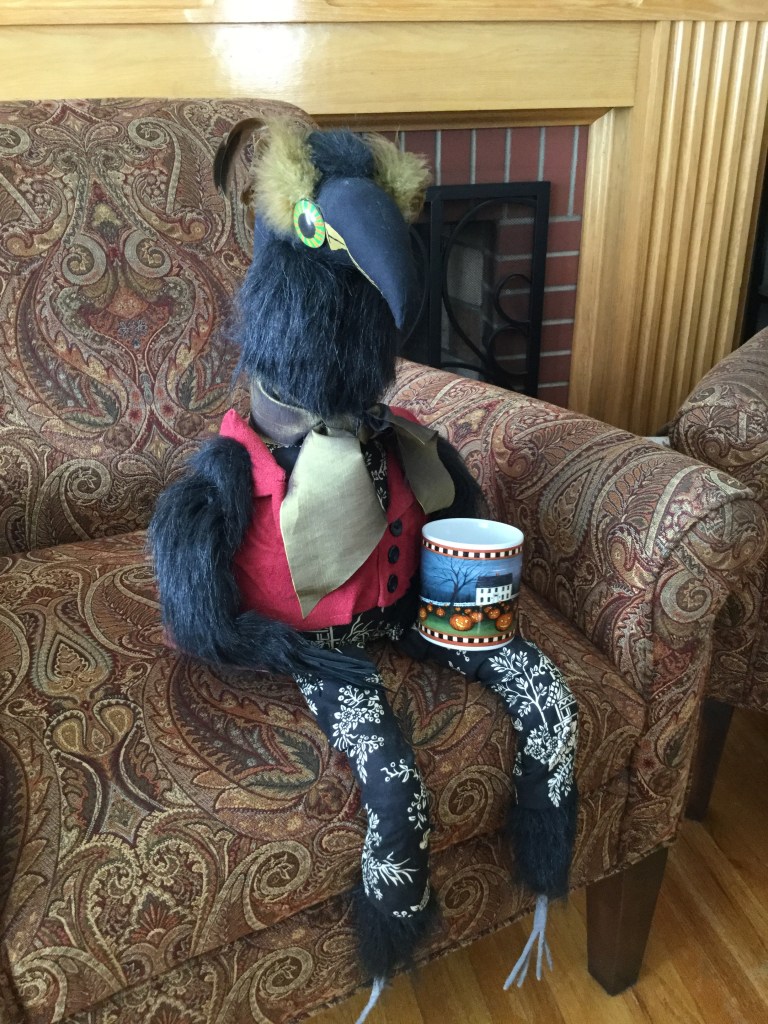
My stepdad and I share a love of nineteenth-century gothic literature, and we’re both particularly obsessed with Edgar Allan Poe. He found this giant stuffed raven in a gift shop years ago. He came with a little booklet tied to his wrist which contains a transcription of Poe’s classic poem. He instantly became a spooky season staple at the homestead, and I love posing him in various places doing various activities. (Ed. Note. I am in love with this raven.)
 Finnian Burnett
Leave a comment