
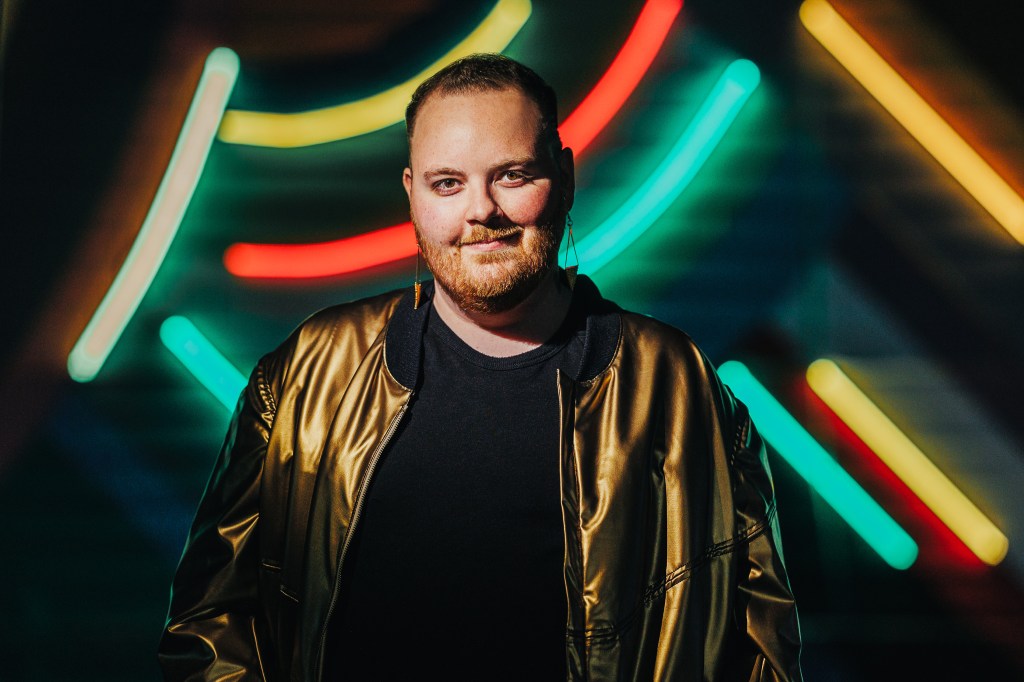
Welcome to the five questions Series. Each week, I’ll ask five questions of some of my favorite authors, editors, publishers, and other industry professionals. This week, I am excited to talk with K.R. Byggdin, author of the gorgeous, poignant book of queer discovery and found family: Wonder World.
Wonder World is one of my favourite books of all time. Can you talk a little about the inspiration for that book?

Well, first of all, thank you—that’s such a kind thing to say! I always want to be clear that Wonder World is a novel, not a memoir, but as I was working on the story, I definitely drew inspiration from my childhood connections to Mennonite communities on the Prairies. I left Manitoba for Nova Scotia in my mid-twenties, and I think that distance created an opportunity for me to reflect on my upbringing more fully, to examine not just the things that were difficult about it but also the things I cherished and missed when I moved away. That process of reckoning or wrestling made its way into my writing as well.
There was also a movement to organize more small-town Pride events around that time. I remember watching CBC’s live broadcast of the first Steinbach Pride Parade in 2016 from afar and feeling my heart bursting with so much admiration and love. That march really pushed back against the false narrative that there are no queer and trans folks in rural and religious spaces or that we don’t belong there. In writing Wonder World, which has its tensions and conflicts but ultimately ends on a moment of hopeful connection, I wanted to offer people a book that would do the same.
How important is it for you to include queer representation in your works?
So important! I think in many ways I write for my younger self, the closeted queer and nonbinary kid who felt like there was no possible future in which they could live openly as their authentic self. I spent the first twenty years of my life internalizing the message that I must remain silent about these central pillars of my identity and personhood. I want to spend the rest of my life reclaiming my voice through the stories I tell, stories that expand the representation and possibilities of queer and gender nonconforming characters in literature.
You won the Thomas Raddall Atlantic Fiction Award for Wonder World. What did that feel like and how did people in your life react?
It’s so wild to consider the journey this book has had, from writing the first draft in 2018 to mentorships, a publishing deal, final edits, and now winning one of Canada’s largest literary prizes in 2023. It felt really special to be recognized by the Atlantic Book Awards in particular because even though Wonder World is largely set in Manitoba, so much of the support and encouragement I received while drafting the story came from my writing community in Nova Scotia. Realistically, most books published by small presses have a very short shelf life before folks move onto the next thing, so it’s been a welcome surprise to have this extended moment of celebration for my debut novel with readers and the people I love.
What are you working on now?
I’ve temporarily relocated from Halifax to Toronto to complete my MFA in Creative Writing and my next novel. There’s no release date yet, but my website krbyggdin.com has links to my newsletter and social media for anyone who’d like to stay informed on what’s next for me.
What advice might you give to other emerging queer authors who are worried their works might not find a home?
Well first of all, I empathise with them, because that’s a fear I’ve had too. I think it’s something our wider culture has conditioned us to feel, but there are definitely publishers out there who are excited to champion new 2SLGBTQIA+ voices. Metonymy, LittlePuss, and Arsenal Pulp Press are three that come to mind right away, but the best advice I can give is this: ask yourself who’s already writing the kind of books you want to write, find out who they’re publishing with, and pitch your work there. You can also follow queer literary awards like the Lammys to see which publishers are being shortlisted in categories of writing that are similar to your own. When you write a query letter, it’s always helpful to compare your manuscript to a few titles the publisher has already released so you can make the case for how your work fits with their back catalogue and how it does something fresh and new.
Before you get to the querying stage though, I think it’s important to plug yourself into a larger writing community, whether that’s in person or online. If you love to write about bisexual mermaids, find some folks who love to write about gay vampires and trans werewolves and start a writing group with them. Seek out people who can help you sharpen your skills as a storyteller without losing the qualities that make your voice uniquely yours. Many local libraries hire writers-in-residence for just this purpose, and a number of provincial writing organizations across Canada such as the Writers’ Federation of Nova Scotia and the Manitoba Writers’ Guild offer more extensive mentorships where you can hone your manuscript with a published author over a period of weeks or months. An agented submission to a major publishing house is not the only way to get your work out into the world. If you encounter people who don’t see your writing as ‘marketable’ because it’s unapologetically queer, they’re not the right fit and not worth chasing.
Bonus question: Have you ever taken a picture of a weird bird?
I have a friend with a bit of a pheasant obsession and every time I see one now it makes me think of him. I’ve definitely stomped on the brakes more than once while driving just to rush into a ditch and snap some blurry bird photos for him. But I think that probably makes me the weird one, not the pheasants!
 Finnian Burnett
Leave a comment